How Casino Imagery Shapes Stories About Quy Nhơn
Casino imagery in Quy Nhơn can shape public stories about a neighbourhood. Learn to separate visible street details from assumptions in captions.
The common mistake in reading casino imagery in Quy Nhơn is treating a sign or doorway as a complete account of the neighbourhood. That shortcut costs the street its context: cafés, shopfronts, passers-by and residents’ own descriptions disappear behind a story built around one venue.
Imagine a hypothetical neighbourhood post showing a brightly lit entrance and calling it “a new casino hotspot”. Before deciding what the post says about local life, ask what is actually known about that street and who is speaking for it. The useful question is not only how the image looks, but how a single venue comes to stand for a place.
Casino imagery in Quy Nhơn can turn a venue into a neighbourhood story
A post about a casino may also make claims about leisure, urban change or local identity. Those claims often rest on a small set of details: an entrance, a sign, a nighttime street or a caption that calls a place “exclusive”. Each detail can direct attention, but none speaks for a whole neighbourhood on its own.
Separate the subject from the claim. A picture may show a lit doorway; a caption may describe the area as changing. The first is a visible detail, while the second needs context beyond the frame.
Write down what the post says about the venue and what it implies about the neighbourhood. Keep those claims distinct.
Street-level context gives public claims their proper scale
Local context means more than naming Quy Nhơn. It can include the surrounding businesses, street signs, the time and setting shown, and whether the post is about one address or a wider part of the city. A tightly framed entrance offers little basis for claims about nearby residents or neighbourhood character.
Public narratives also depend on whose account is being shared. A venue’s promotional post, a resident’s photograph and a news report may all show the same entrance, yet address different audiences and purposes. Look for the publisher and any explanation of why the image was made; do not treat one voice as a community consensus.
Keep the scale of your description no broader than the evidence in front of you.
Borrowed casino language can obscure local meanings
Words such as “hotspot”, “hidden gem” and “taking over” carry ready-made associations. They can make a venue sound fashionable, secretive or threatening before a reader knows what the writer means. Those labels may draw on familiar entertainment imagery rather than details specific to Quy Nhơn.
Local language matters because residents, visitors, businesses and publishers may describe the same area differently. A caption that says “locals love it” does not establish what residents think. Treat broad claims about a community as the author’s framing unless the post provides clear context for them.
When a label does a lot of work, ask who chose it and what it leaves unsaid.
How can you assess a casino post fairly?
What does the post actually show?
Name visible details such as a sign, doorway or adjoining shopfront before describing the mood. If the image hides the wider street, limit your account to what is in the frame.
Who published the image?
Check whether the account appears promotional, personal or journalistic, and read any accompanying explanation. The publisher can help clarify the post’s purpose, but it does not by itself settle whether a broader claim is accurate.
Does the caption speak for residents?
Look for wording that attributes an opinion to “locals” or a neighbourhood. If the post offers no context for that claim, describe it as the author’s assertion rather than a shared view.
How broad is the claim about the place?
Compare the scope of the wording with the scope of the evidence. A photograph of one entrance can support a description of that entrance, but not by itself a claim about change across the city.
A worked reading keeps the claim close to the evidence
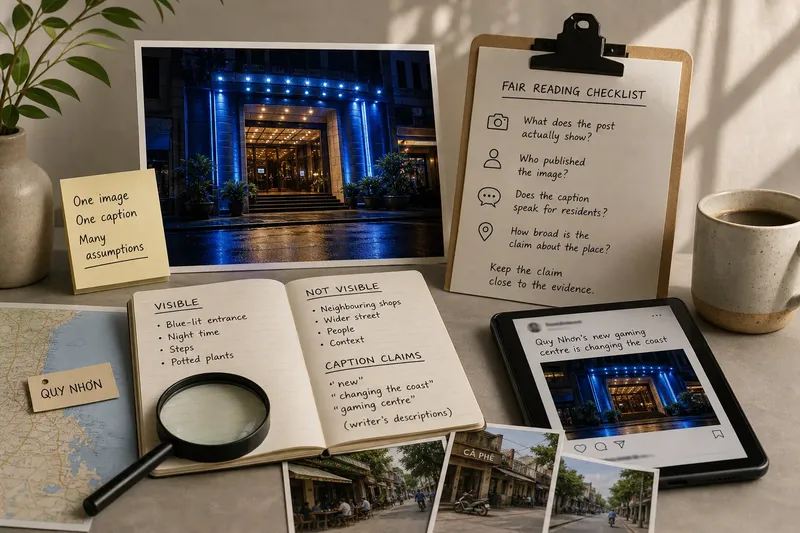
Say a hypothetical post contains one night-time photograph of a blue-lit entrance and the caption “Quy Nhơn’s new gaming centre is changing the coast”. The starting material is one image and one caption; it includes no wider street view, source explanation or account of what “changing the coast” means.
First, record the visible details: one entrance, blue lighting and a nighttime setting. Next, note what is missing from the frame: neighbouring businesses and the wider street. Then separate the caption’s claims: “new” and “changing the coast” are the writer’s descriptions, while “gaming centre” is a label whose basis is not established by the image.
The resulting reading is narrow but useful: the post presents one entrance as part of a larger story about change, while the image alone cannot establish that wider story. A reader can ask what the writer means or seek more local context without repeating the caption as fact.
Practical checks help keep a description fair
- Check the crop: If the image excludes nearby shops and the wider street, then describe a tightly framed entrance; if it shows the surroundings, then name only the street details that are actually visible.
- Check the wording: If the caption uses “new” without explaining its basis, then attribute “new” to the caption; if it gives context, then describe that context without extending the claim.
- Check the publisher: If the account promotes a venue, then identify the post as promotional; if the account’s purpose is unclear, then avoid assigning it a motive and describe the source as uncertain.
- Check claims about residents: If the post says “locals think” without explaining whose views it represents, then attribute the claim to the post; if it identifies a specific speaker, then name that speaker rather than a whole community.
- Check the place named: If the post names Quy Nhơn but shows no location detail, then do not infer a particular neighbourhood; if a street or landmark is visible, then identify only what the image supports.
- Check the scope: If one venue is used to claim that the city is changing, then keep your description to that venue; if the post supplies broader context, then state exactly what that context covers.
These checks are useful when discussing a post with friends or writing a caption of your own. A precise description leaves room for local context instead of speaking over it.
Careful wording leaves room for more than one local view
Casino imagery in Quy Nhơn can prompt conversation about entertainment and neighbourhood identity, but a single image cannot settle those questions for residents. Describe what is visible, attribute claims to their source and be cautious when a post turns one venue into a story about an entire area.
When you share or discuss casino imagery in Quy Nhơn, name the street-level details that support your point and mark the claims that come from someone else. That small distinction helps keep a conversation about a place open to the people who know it in different ways.