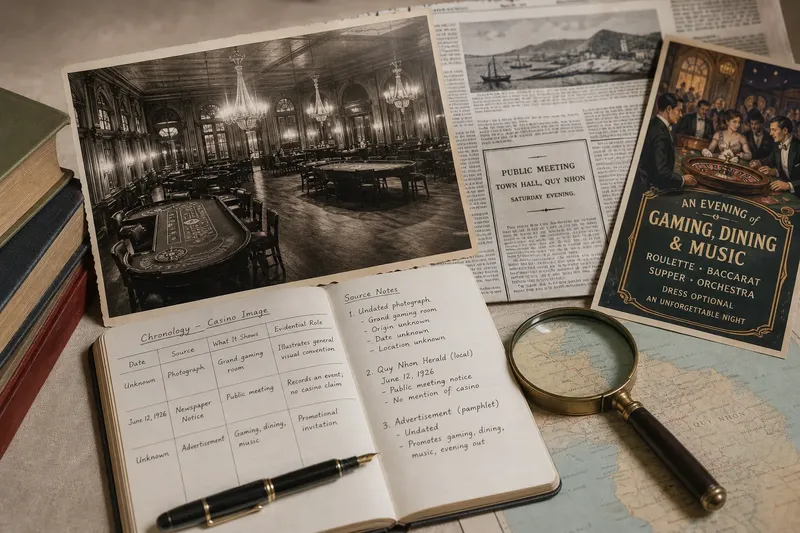
How Casino Stories Turn Quy Nhơn into a Setting
See how casino stories place Quy Nhơn on a casino journey, and distinguish a destination, a stopover and a scene from the place where gambling happens.
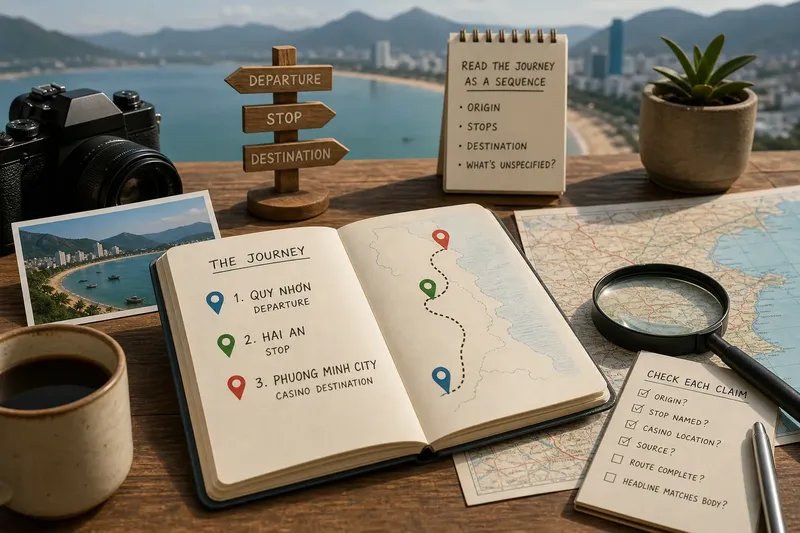
The common mistake in reading casino stories about Quy Nhơn is to treat any mention of the city as proof that gambling happens there. That can send readers looking for a venue the story never identifies, while obscuring the more useful question: what part does the city play in the journey being described?
Casino stories place Quy Nhơn along different routes
A city can be the trip’s starting point, a stop along the way, the destination itself, or merely the location named in an advertisement. These roles are not interchangeable. A story about a visitor travelling from Quy Nhơn to a casino elsewhere is about movement between places, not evidence of a casino in Quy Nhơn.
Follow the route in the text. Look for the named departure point, any intermediate stops, the venue’s stated location and the point at which the account ends. If one of those details is missing, leave it unresolved rather than filling the gap with the city’s name.
Keep the place where a journey begins separate from the place where its main event occurs.
Read the journey as a sequence, not a backdrop
Route language can quietly shape a reader’s understanding. “Travellers from Quy Nhơn” identifies an origin; “a casino near Quy Nhơn” makes a location claim; “a trip through Quy Nhơn” suggests a stop or passage. Each phrase calls for different supporting detail.
Check whether the account names actual places along the route, or relies on broad words such as “gateway” and “coastal escape”. Those phrases may describe a promotional image rather than a documented itinerary. A map can help check the geography, but it cannot establish that a particular person made the journey.
When the route is incomplete, describe only the leg the story makes clear.
Distinguish the city’s role from the casino’s location
These are separate questions: where does the story place Quy Nhơn in the journey, and where does it place the casino? A clear answer to one does not settle the other. A report may identify Quy Nhơn as a traveller’s home while naming a venue in another city; it may also mention a casino without giving its location.
Notice where the reporting becomes specific. A named venue, an address or an attributed account can clarify the casino’s setting. A coastline in the opening paragraph cannot do that work by itself. If the article does not name a location, write that the location is unspecified.
In a summary, keep the two place claims in separate sentences if that makes the route easier to follow.
How can you trace Quy Nhơn’s role in the story?
Does “from Quy Nhơn” mean the casino is there?
No. It normally marks a point of origin, but the rest of the account must establish where the casino is. Keep the destination open if the story does not name it.
What does “gateway” tell me about the route?
It suggests access or passage, but it does not identify a specific journey on its own. Look for a named destination, transport link or attributed itinerary before describing a route as reported fact.
Can a map confirm the route in a story?
A map can help you see whether named places fit the geography. It cannot verify that a person travelled that route or establish details the account leaves out.
How should I describe an unclear destination?
State what the story does identify, such as a departure from Quy Nhơn, then say that it does not specify the destination. Avoid turning an incomplete route into a local casino claim.
Check each place claim before sharing it
- Observe whether Quy Nhơn is named as a departure point. If the text says a traveller leaves from the city, describe it as the origin; if it only mentions the city without a route, call its role unclear.
- Observe whether the casino has a named location. If a venue or city is identified, report that location; if not, say the casino’s location is unspecified.
- Observe whether an intermediate stop is named. If the account identifies one, include it as a stop; if it does not, do not add a stop based on a map or assumption.
- Observe who uses terms such as “gateway”. If the phrase comes from an advert or quoted speaker, attribute it; if its source is unclear, describe it as the story’s wording.
- Observe whether the journey is presented as a reported event or a proposed itinerary. If the text describes a specific person’s trip, summarise it as that account; if it presents only an option, do not say the trip took place.
- Observe whether the headline and body name the same destination. If they differ, quote or summarise the body’s more specific account and note the discrepancy; if neither names a destination, leave it unspecified.
Say you are reading an invented travel feature that names Quy Nhơn as a departure point, includes one fictional stop, and locates its casino in another fictional city. You record the three place names in order, then check that the body—not just the headline—supports each role. If the body confirms the departure and venue but says nothing about the stop, your summary names Quy Nhơn as the origin and the other city as the casino location, while leaving the intermediate route unconfirmed.
Describe the route without assigning the city a role it has not earned
Casino stories about Quy Nhơn can be read more clearly by tracing where people begin, pass through and arrive, while keeping the venue’s location distinct. Attribute promotional route language, and mark missing details as missing rather than treating them as clues.
For a concise account, name the supported starting point and destination, then state plainly if the route or venue location remains unspecified. That small distinction lets readers understand what the story says about Quy Nhơn without mistaking a place on the way for the place where gambling happens.