How Casino Language Shapes Quy Nhơn’s Public Image
Explore casino language in Quy Nhơn through headlines, metaphors and quoted voices, and describe a story’s tone without mistaking it for the city’s whole conversation.
The common mistake in reading about casino culture in Quy Nhơn is treating the word “casino” as a neutral label. It can lend a sentence glamour, risk or commercial promise before the story explains its subject. To read the language closely, notice not only what the word names but what it is made to suggest.
Casino language in Quy Nhơn depends on its company
“Casino” can refer to gaming, evoke a leisure setting or serve as shorthand in a wider discussion about tourism. Adjectives and neighbouring nouns narrow that meaning. “Casino resort” evokes an integrated holiday setting; “gaming venue” puts the activity in the foreground; “casino proposal” describes an idea under discussion rather than an established place.
Those phrases do more than label. They give readers a ready-made way to imagine the subject. A writer can make gaming sound like entertainment, a business proposition or a matter for public discussion without changing the underlying word.
Try replacing the label with the precise thing the sentence describes. If it refers to a proposal, call it a proposal; if it discusses gaming, name gaming. Specific wording leaves less room for a reader to mistake an association for a fact.
Metaphors turn gaming into a story
Casino coverage often borrows language from other subjects. “A roll of the dice” can frame a decision as risky; “jackpot” can suggest sudden success; “high stakes” can make a disagreement sound dramatic. Such phrases may be vivid, but they also carry assumptions into a story before its evidence has been considered.
Notice whether a metaphor describes an actual gaming scene or is being used figuratively. If a headline calls a commercial decision “a gamble”, it has chosen a dramatic interpretation. That does not establish that the decision is reckless or likely to succeed.
Read the literal claim separately from the flourish.
Tourism vocabulary can soften or sharpen the subject
Words such as “leisure”, “nightlife” and “entertainment” place gaming within a recreational frame. Terms such as “licensing”, “rules” and “oversight” direct attention towards governance. A story may move between these vocabularies, but they answer different questions: what experience is being promoted, and what framework is being described?
Adjectives matter as well. “Exclusive”, “vibrant” or “controversial” may express a promotional or critical tone. Ask who chose the word and whether the article supports that characterisation with details, rather than adopting it as your own description.
Say you encounter an invented headline, “Quy Nhơn’s vibrant casino future”, above a short article about a proposed development. The adjective “vibrant” supplies an upbeat tone, while “future” and “proposed” indicate that the piece is discussing a possibility. A careful note would call it an upbeat account of a proposal, not a description of an existing venue.
Quoted voices reveal a story’s vocabulary choices
Speakers can introduce distinct terms for the same subject. A business representative may talk about visitors or investment; an official may use the language of rules; a resident may describe a concern in everyday words. These voices show how the article has assembled its account, not how every person in Quy Nhơn speaks or thinks.
When a quotation contains a loaded phrase, keep the attribution attached. Write “the promoter describes the proposal as ‘vibrant’” rather than “the proposal is vibrant”. The first reports a speaker’s wording; the second adopts it.
Record the speaker, the term they use and the issue they address. This makes your reading note more precise than a broad label such as “positive coverage”.
How should you read casino wording in a story?
What does “casino resort” imply?
It suggests that gaming is being presented alongside accommodation or leisure facilities. The phrase alone does not establish which facilities exist or how they are connected; check the story’s specific wording.
How can you tell promotion from description?
Look for approving adjectives, invitations to visit and language focused on appeal. Then separate those choices from concrete details such as what the story says is planned or operating.
What should you do with a gambling metaphor?
Identify the literal subject first, then note the metaphor as the writer’s framing. Do not let a phrase such as “a roll of the dice” stand in for evidence about risk or outcome.
How should you report a quoted opinion?
Name the speaker and preserve the attribution when paraphrasing. A quotation represents that speaker’s view in the story; it does not, by itself, represent public opinion.
Check six language cues before describing the coverage
Use these observations to make a grounded note about wording. Each cue points to a decision, including what to do when the story leaves something unclear.
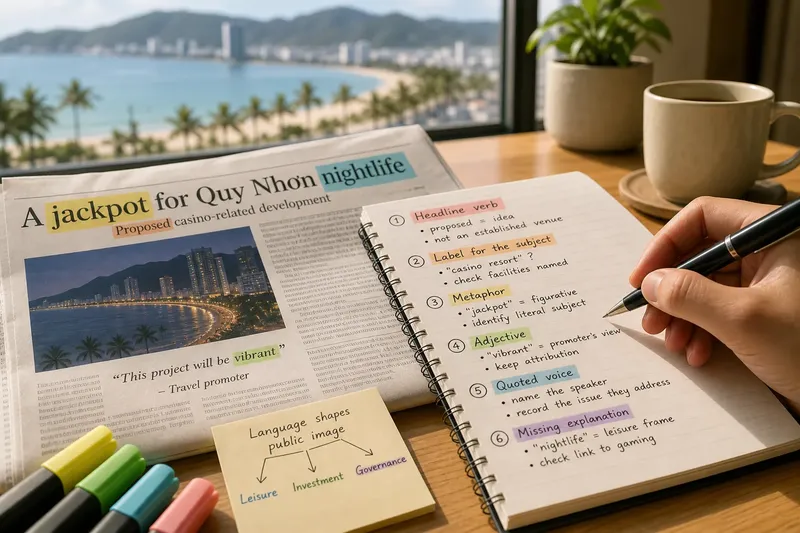
- Headline verb: If it says “proposes”, describe a proposal and check whether the article identifies what is proposed; if it uses a dramatic verb without explaining the action, describe the headline as dramatic and do not infer an event.
- Label for the subject: If the story says “casino resort”, check whether it names accommodation or other facilities; if it does not, record the phrase as a label rather than treating those facilities as established.
- Metaphor: If a phrase such as “jackpot” is figurative, identify it as the writer’s flourish; if the story is describing literal gaming, keep that account separate from any figurative claim about success.
- Adjective: If a word such as “vibrant” or “controversial” is attributed to a speaker, keep the attribution; if it appears in the writer’s own narration, describe it as the article’s characterisation rather than a neutral fact.
- Quoted voice: If a speaker is named, note their role and the issue they address; if the story gives no role or attribution, avoid treating the quotation as representative and describe that limitation.
- Missing explanation: If the article uses “leisure” or “investment” without explaining the connection to gaming, keep those ideas distinct; if it supplies a connection, repeat only the relationship the text actually states.
Imagine an invented draft with the headline “A jackpot for Quy Nhơn nightlife”, a paragraph describing a proposed casino-related development, and a quotation from a travel promoter calling it “vibrant”. Start with the wording: “jackpot” is a metaphor, “nightlife” supplies a leisure frame, and “proposed” marks the development as an idea rather than an established venue. Next, attribute “vibrant” to the promoter instead of adopting it as fact. If the draft gives no explanation of how the proposal relates to nightlife, keep those ideas separate. The resulting note could read: “The draft uses an upbeat nightlife frame and a success metaphor to discuss a proposal, while its positive adjective belongs to the quoted promoter; it does not explain the link between the proposal and nightlife.”
Describe the language without adopting its claims
Casino language in Quy Nhơn can be promotional, dramatic, recreational or regulatory, sometimes within the same story. Name the specific word or metaphor that creates that tone, and distinguish a quotation from the article’s own account.
That small act of attribution is useful when sharing or discussing a story. It lets you say what the language does, while leaving room for clearer reporting to establish what the words alone cannot.